
Ayup! This one’s for any fellow photographers or bloggers out there. If you’re considering setting up a website like this one, here’s how I made it.
My entire site is now constructed with the tools already built into WordPress. I’ve got a couple of plugins installed, but nothing that affects how it appears. If I deleted them, everything would still look and function in the same way.
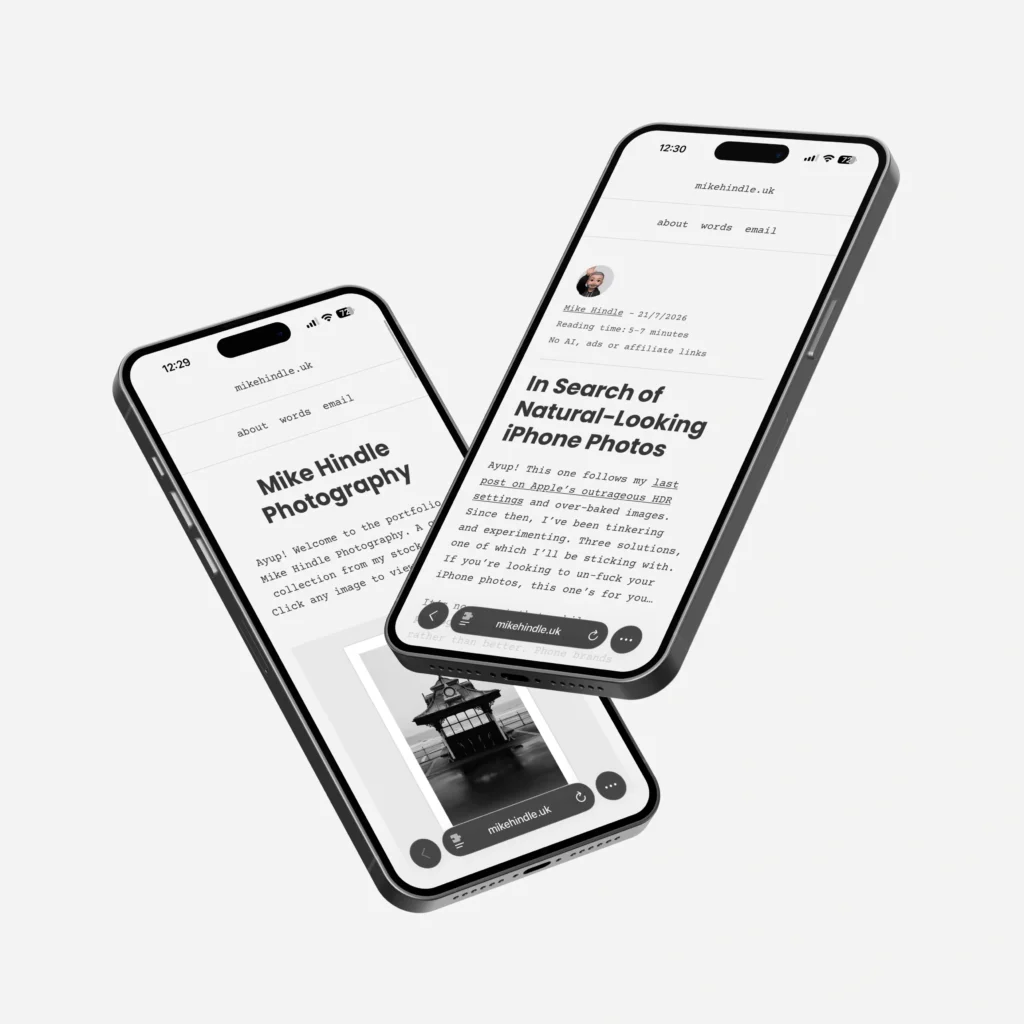
The Minimalist WordPress Stack
My brain doesn’t handle chaos too well. In fact, it descends into meltdown mode with even the slightest whiff of it. For that reason, I love to keep things simple. Clean, calm, and minimalist on both the front and back end.
Over the years, I’ve gradually been able to eliminate more and more external tools. Not that there’s anything wrong with these (within reason), but if we can get by without them, all the better.
Here’s a rundown of everything I’m currently using…
1. Rocket.net Web Hosting
This section was originally 20i hosting, but I’ve since moved over to Rocket.net. I’ve used them before and know that things just work. Something that shouldn’t be overlooked when it comes to stress-free website building.
Rocket by name, rocket by nature. It’s lightning fast, secure, and the support is phenomenal. The user interface is extremely intuitive, with a beautiful, clean layout and design. Also, if you want to migrate a previous WordPress site over, they do most of the hard work for you.
Host the fastest WordPress websites that are pre-configured for maximum speed, helping you get higher conversions & SEO scores.
Your websites are always online and safe from cyber attacks thanks to our enterprise-level WordPress security configurations.
2. Default Theme
When you first log into your new WordPress site, it will have the default theme installed. This is called Twenty Twenty-Five. It’s one of several available block themes. Personally, I’d say it’s the only one you really need.
It keeps things as close to working purely with WordPress as possible. Block themes take a little getting used to, but it’s well worth persevering. Once you’ve found your feet, there’s not much you can’t do with them.
The main advantage is the level of control you have over every single aspect of your site. On a platform like Squarespace, your blog looks how they want it to look. With a WordPress block theme, you can customise the look, layout and spacing so that it’s exactly how you want it.
Twenty Twenty-Five emphasises simplicity and adaptability. It offers flexible design options, supported by a variety of patterns for different page types, such as services and landing pages, making it ideal for building personal blogs, professional portfolios, online magazines, or business websites.
3. Block Editor
WordPress comes with a perfectly capable editor. This is how you can build and then edit your site. It’s known as the block editor and lets you add a wide range of blocks to your pages or posts.
For example, this is a paragraph block inside a group block. The group block has a 1px border and padding on all sides so the text doesn’t go right to the edge.
With headings, groups, columns, galleries and much, much more, you can build everything you’ll ever need on your portfolio and blog.
The WordPress block editor offers an array of blocks that can be used to create media-rich pages and posts.
Blocks are the content elements that you add to create content layouts. You can add blocks for paragraphs, images, headings, lists, videos, galleries, and more. You can control the layout of the blocks with ease, to build visually appealing web pages.
4. Gallery Block
For the main portfolio on my homepage, I’m using the WordPress Gallery block. This will only work if all your images have the same aspect ratio. Although mine are a mix of portrait, landscape and square, I’ve placed them all within a square image.
You can link your image to a webpage as I have, or set it to enlarge when clicked on. The latter is really beautifully done. The photo zooms in from wherever it is on the screen to the centre. Smooth!
The masonry layout, which is meant to fit images of all different aspect ratios together, doesn’t currently work. If you’d prefer this style of gallery, I can highly recommend using Kadence Blocks. Their advanced gallery will let you set this up with minimal effort.
The Gallery block allows you to easily add multiple photos and automatically arrange them in a gallery. You can control the number of columns and the size of the images in the gallery.
5. Plugins
As mentioned, you can build out your entire site using only the above tools. That said, WordPress doesn’t come with any SEO or analytics options. If you want your content to be found and to see how many visitors you’re getting, I can highly recommend:
- SureRank – A modern SEO plugin with a clean, intuitive interface.
- Koko Analytics – Simple, privacy-focused, GDPR compliant stats.
I’ve written a couple of blog posts on the above plugins. Check them out if you want any further info:
For every page, post, and product, SureRank lets you manage SEO titles, meta descriptions, indexing settings, Open Graph tags, schema markup, and more — all in one place. Fast to configure and built for real-world SEO needs.
Build More With Less
These days, WordPress makes it super-easy for non-developers (like me) to build their own website. Think Wix and Squarespace, but with infinitely more control and precision.
All you need is hosting, WordPress (with the default theme/built-in editor), and a couple of optional plugins. A minimalist set-up for a distraction-free website. Paired with a clean, calm and contemporary design, your visitors will be drawn to one thing, and one thing only: your content. Happy days!